If you own Australian property from overseas and need extra capital, you do not have to refinance your whole bank loan. A second-ranking mortgage can release a further AUD 1M–5M against your existing equity while the original bank facility stays exactly where it is. Global Mortgage Group (GMG) helps overseas-based borrowers, including Australian expats and permanent residents, arrange this, often without requiring Australian income or credit, subject to assessment of the property and the transaction.
What the RBA just did
On 29 September 2026, the Reserve Bank of Australia raised the cash rate by 25 basis points to 4.60%. The board's vote was unanimous. It is the fourth increase of 2026 and takes the cash rate to its highest level in 15 years, since late 2011.
Banks are already passing it on. Commonwealth Bank has announced a 0.25% increase to its variable home loan rates from 9 October, and Macquarie follows from 15 October. The RBA has also said it will keep raising rates if needed to bring inflation back to target. Q3 inflation data is due on 28 October, a week before the board next meets, and some economists are pencilling in another 25bp increase.
For an overseas investor who needs extra capital, it raises a hard question: is it sensible to refinance a large facility at today's rates, or at even higher rates in future, just to access a smaller amount of new money?
The dilemma: lots of equity, but the wrong moment to refinance
Many international owners of Australian property are in the same position. The asset has grown in value. The equity is substantial, even as valuations have recently softened. But the existing bank loan was written at a different point in the rate cycle, and replacing it means repricing every dollar.
Here is a typical example:
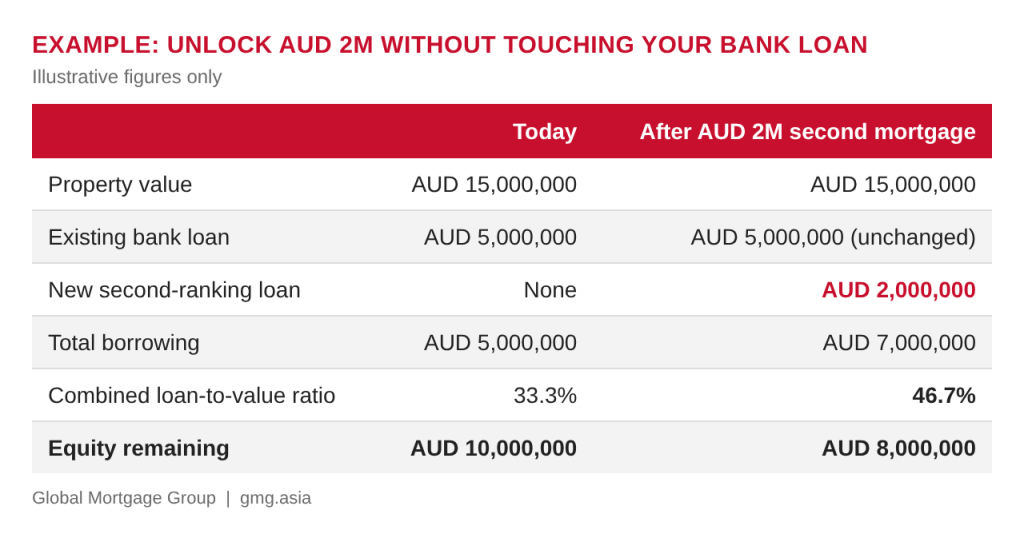
The investor has AUD 10 million of equity and needs AUD 2 million. Even after the new loan, the combined borrowing sits below half of the property's value.
Why refinancing the whole facility may not make sense
Refinancing the existing AUD 5M loan into a new AUD 7M facility has several consequences worth weighing:
- Everything reprices. The full AUD 7M moves to today's rate, not just the extra AUD 2M. Each 1.00 percentage point of rate is worth about AUD 70,000 a year on AUD 7M, versus AUD 20,000 on AUD 2M.
- Fixed-rate and exit costs. Breaking a fixed-rate loan early or discharging a facility can trigger fees.
- Bank assessment. Mainstream lenders typically assess income, credit history and serviceability. For overseas-based owners with foreign income, that process can be slow or restrictive.
- Timing. A full refinance means a new valuation, new credit approval and a full settlement process, even when you only need a fraction of the equity quickly, whether to seize an investment or business opportunity or to meet expenses.
The alternative is a second-ranking mortgage: a loan secured against the same property that ranks behind your bank mortgage, leaving that loan in place on its existing terms. A bridging loan secured this way will usually carry a higher rate than a first-ranking bank loan, so the right comparison is blended cost: the existing loan at its current rate plus the new loan at its rate, against the whole amount at a new bank rate.
How GMG can help
We regularly consider situations that fall outside the usual lending parameters:
- Smaller loan amounts of AUD 1M–5M, often below the minimums that some specialist or institutional lenders will accept
- Second-ranking mortgages where appropriate, even if the first-ranking loan is provided by a non-bank lender
- Overseas-based borrowers, including Australian expats and permanent residents (PRs). Typically no Australian income or credit required
- Property held in personal names, not necessarily through companies, trusts or SPVs
- Flexible use of funds, including business expenses and investments within and outside Australia
Each case is assessed on the property, the existing facility, use of funds, the combined loan-to-value ratio and the exit strategy. Terms vary by deal.
How it works
- Share the basics. Property location and estimated value, existing loan balance and lender, amount needed, intended use and exit plan.
- We assess the structure. We check how a second-ranking position would work alongside your existing bank mortgage, including any requirements of the first lender.
- Indicative terms. We take the opportunity to suitable lenders and come back with indicative terms and the blended-cost comparison against refinancing.
- Valuation, legal and settlement. A valuation and legal documentation follow, with funds released at settlement.
Who this suits
- Overseas owners of Australian property with significant equity and an existing bank loan they would prefer not to disturb
- Australian expats and PRs living abroad without local income or credit footprint
- Investors and business owners who need capital in a defined window, for opportunities inside or outside Australia
- Private banking and wealth advisers with clients in this position. Refer the opportunity and keep the client relationship
Who it may not suit
If you need a very long-term facility at the lowest possible rate and you qualify for mainstream bank credit, refinancing may be the better route. We will tell you if that is the case.
Frequently asked questions
Q1: What is Australia's cash rate now?
The RBA cash rate is 4.60%, set on 29 September 2026. It is the fourth increase of 2026 and the highest level in 15 years.
Q2: Can I borrow against my Australian property without refinancing my existing bank loan?
Often, yes. A second-ranking mortgage allows you to borrow additional funds against the same property while your existing bank loan stays in place. Feasibility depends on the property, the combined loan-to-value ratio and the terms of the first mortgage.
Q3: Can overseas residents, expats and PRs borrow against Australian property?
Yes. GMG works with overseas-based borrowers, including Australian expats and permanent residents. Typically, no Australian income or credit is required, though the property and transaction are assessed.
Q4: What loan sizes do you consider?
We look at loans from AUD 1M to AUD 5M, including amounts below what some specialist or institutional lenders will consider.
Q5: Does the property need to be held in a company or trust?
No. Properties can often be owned in personal names, not necessarily through companies, trusts or SPVs.
Q6: What can I use the funds for?
Use of funds is flexible, including business expenses and investments within and outside Australia.
Q7: Is a second mortgage more expensive than a bank mortgage?
It typically carries a higher rate than a first-ranking bank loan. The right test is blended cost over the period you need the funds, compared with refinancing the entire facility at today's rates. We run both comparisons for you.
Talk to us
If you have Australian property, an existing bank loan and a funding need, tell us the numbers and we will tell you whether a second-ranking structure makes sense.
Donald Klip, Head of GMG Capital Advisory
Book a 15-minute call: https://calendly.com/gmgdonald/15min
Email: [email protected]
WhatsApp / mobile: +65 9773-0273